Author: admin

  • ¿Han afectado las nuevas tecnologías al empleo?

    ¿Han afectado las nuevas tecnologías al empleo?

    El debate actual sobre la aplicación de las nuevas tecnologías a todo tipo de ámbitos no cesa. Cada vez son más los autores que estudian las repercusiones (positivas y negativas) que estas puedan tener en la sociedad a corto plazo. Principalmente, el tema que más parece preocupar es el empleo. De hecho, se predice que la pérdida de empleo debida a la IA afectará a todo tipo de trabajadores, no solo obreros, pues la IA es cada vez más capaz de realizar tareas cognitivas complejas (Coeckelbergh, 2020).

    Pero, ¿están afectando actualmente las nuevas tecnologías a la generación de empleo?

    Recientemente, el Banco de España ha publicado un estudio en el que se analiza el impacto de las últimas herramientas tecnológicas en el empleo. Según los datos publicados, la ocupación ha crecido más en las actividades profesionales en las que ha habido un mayor uso de la Inteligencia Artificial (IA). Además, el impacto ha sido todavía mayor en aquellas profesiones con más presencia de jóvenes y trabajadores cualificados profesionalmente.

    Para poder llegar a esta conclusión, el estudio ha tenido en cuenta datos de 15 países de Europa correspondientes al periodo comprendido entre 2011 y 2019. Con los resultados presentados se ha podido contribuir a disipar temores relacionados con el uso de nuevas tecnologías. Por ejemplo, el miedo a que la IA pueda acabar en una destrucción masiva de empleos.

    Además, estos resultados refuerzan la teoría del “cambio tecnológico sesgado por las habilidades”, que defiende que el uso de tecnologías genera trabajadores mejor formados. Es por ello que el uso de estas nuevas herramientas (como la IA) puede provocar un aumento en el empleo, aunque también debería observarse un incremento en los salarios. En este sentido, el estudio ha encontrado “poca evidencia de relación entre salarios relativos por ocupaciones y exposición potencial a las nuevas tecnologías”.

    En referencia a los resultados concretos de cada país participante en este estudio, existe cierta heterogeneidad. Sólo unos pocos países muestran una disminución de empleo. Según el indicador elaborado por el economista Michael Webb, los datos correspondientes a Grecia muestran claramente una disminución de empleo. En Irlanda, Alemania, Italia y Lituania no hay apenas variaciones en materia de puestos de trabajo. Finalmente, los tres estados donde se crean más empleos en las profesiones con mayor exposición a la IA son: Luxemburgo, Estonia y Bélgica.

    Los autores de la investigación destacan que actualmente la IA está en constante desarrollo y es posible que las conclusiones alcanzadas en este estudio puedan no ser válidas en un futuro no muy lejano. Además, recuerdan que la IA facilita la automatización de tareas y no parece favorecer la creación de muchas tareas nuevas.

    Por otro lado, también es imprescindible tener en cuenta el informe “El Futuro del Trabajo” que ha publicado el Foro Económico Mundial. En este documento se manifiesta que se experimentarán grandes cambios en los próximos cinco años debido al avance de la tecnología.

    El reporte plantea que en 45 economías (con 673 millones de puestos de trabajo) se crearán 69 millones de nuevos puestos de trabajo y la supresión de 83. De cumplirse las previsiones, supondrá una disminución del 2% del empleo actual.

    Finalmente, y de cara al futuro próximo, resulta de vital importancia formarse en las nuevas habilidades digitales. La evolución del mercado laboral estará marcada por la desigualdad entre quienes tienen formación y capacidad para adaptarse a un nuevo entorno tecnológico y quienes, por el contrario, no tienen acceso a estas competencias digitales.

    Bibliografía

    Albanesi, S., Dias da Silva, A., Jimeno, J. F., Lamo, A., & Wabitsch, A. (2023). New technologies and jobs in Europe. Bank of Spain.

    Coeckelbergh, M. (2020). AI Ethics. MIT Press.
  • Have New Technologies Affected Employment from 2011 to 2019?

    Have New Technologies Affected Employment from 2011 to 2019?

    The ongoing debate about the application of new technologies to various areas has been gaining more attention. Many experts are examining the positive and negative impacts that these technologies might have on society in the short term. The primary concern is the effect on employment. It is projected that job losses due to AI will impact all kinds of workers, not just those in blue-collar jobs, as AI is becoming more and more capable of performing complex cognitive tasks (Coeckelbergh, 2020). However, it raises the question of whether new technologies are currently influencing job creation.

    New Technologies in an AI Study Deters the Labor Force

    Recently, the Bank of Spain published a study analyzing the impact of the latest technological tools on employment. Based on published data there has been a greater use of Artificial Intelligence (AI) in employment growth of professional activities. Moreover, the impact has surpassed in those professions with more presence of young people and professionally qualified workers.

    The study analyzed data from 15 European countries between the years 2011 and 2019 concluded. This study’s results concluded that AI could lead to a significant loss of jobs. Likewise, it helps dispel fears surrounding the use of new technologies.

    These results also support the theory of “skill-biased technological change.” This suggests that using advanced technologies creates a demand for better-skilled workers. As a result, adopting new tools, including AI, can lead to an increase in employment and an increase in wages. Moreover, the study found little evidence of a relationship between relative wages by occupation and potential exposure to new developments in AI.

    Regarding the study, there are some differences between the countries that participated. Only a small number of countries experienced a decrease in employment. Economist Michael Webb’s indicator shows a decline in employment rates for Greece. On the other hand, there is little to no change in job numbers for Ireland, Germany, Italy, and Lithuania. Finally, Luxembourg, Estonia, and Belgium are the top three countries with the most jobs created in professions with the highest exposure to AI.

    Constant Development in New Technologies

    The authors of the research emphasize that AI is currently under constant development. The study’s conclusions may not be valid in the not-too-distant future. Moreover, they recall that AI facilitates the automation of tasks and does not seem to favor the creation of many new jobs.

    On the other hand, it is also essential to observe the report “The Future of Work” published by the World Economic Forum. This document also states that in the next five years, we will experience changes due to technological advances.

    The report states that in 45 economies (with 673 million jobs), 69 million new jobs will be created, and 83 million jobs will be eliminated. If the forecasts are fulfilled, it will mean a 2% decrease in current employment.

    Finally, and with a view to the near future, it is vital to receive training in the era of digital skills. The evolution of the labor market will be marked by inequality between those who have the training and the ability to adapt to a new technological environment and those who, on the contrary, do not have access to these digital skills.

    References

    Albanesi, S., Dias da Silva, A., Jimeno, J. F., Lamo, A., & Wabitsch, A. (2023). New technologies and jobs in Europe. Bank of Spain.

    Coeckelbergh, M. (2020). AI Ethics. MIT Press.
  • La Experiencia de la IA en la Industria Alimentaria

    La Experiencia de la IA en la Industria Alimentaria

    El rápido crecimiento de la IA ha surgido en la industria alimentaria. Los clientes pueden experimentar los beneficios de la implantación de la IA en cadenas de restaurantes y fabricantes de alimentos. ¿Cómo?

    Soluciones de autoservicio en la Industria Alimentaria

    Echemos un vistazo a una cadena de restaurantes que implementó la IA antes de la pandemia. En 2022, Panera Bread introdujo Tori, un sistema automatizado de pedidos por voz en el autoservicio. Los clientes estaban satisfechos con Tori, ya que les permitía hacer sus pedidos y luego les hacía preguntas de seguimiento. Al final del pedido, Tori se lo leía todo al cliente. La cadena de restaurantes Popeyes también tuvo éxito con el sistema de pedidos por IA. Según Insider, la franquicia de cocina al estilo de Luisiana experimentó un aumento de la velocidad de servicio del 20%. También aumentaron las ventas de bebidas en un 150%.

    Pizza más inteligente en la Industria Alimentaria

    Más recientemente, la innovación también ha alcanzado su punto álgido con Domino‘s, la mayor empresa de pizzas. Están colaborando con Microsoft para generar soluciones de IA para pedidos de pizza personalizados. El objetivo del asistente de IA generativa impulsado por Azure OpenAI Service es ayudar a los gerentes de tienda ahorrando tiempo en las tareas diarias. Por ejemplo, proporcionará a los gerentes de tienda más tiempo para el equipo y el servicio al cliente. Realizará tareas tediosas como la gestión del inventario, el pedido de ingredientes y la programación del personal.

    La colaboración de Domino’s con Microsoft explotará en su Laboratorio de Innovación. Los ingenieros han unido sus fuerzas para acelerar el tiempo de comercialización de tiendas inteligentes y pedidos de pizza más inteligentes. El uso de Microsoft Cloud y el servicio Azure OpenAI proporcionará personalización y simplificación al proceso de pedido de pizza de los clientes.

    Fabricantes de alimentos en la Industria Alimentaria

    Nestlé ha implementado el uso de ChatGPT 4.0 y Dall-E 2 para promocionar sus productos. Sorprendentemente, Aude Gandon, Directora Global de Marketing de Nestlé, declaró que el uso de IA generativa proporciona varias ideas que el equipo creativo desarrollará más adelante como contenido para sus sitios web.

    Por ejemplo, Nestlé utilizó la función AI DALL.E Outpainting para ampliar la escena en torno al emblemático cuadro de Johannes Vermeer “La lechera”. En esta nueva campaña, el equipo creativo de Ogilvy Paris dio instrucciones de texto. A continuación, la IA respondió generando nuevas imágenes artísticas sin perder de vista el “óleo sobre lienzo” original. La figura de la lechera se amplía mostrando personajes que la observan con asombro mientras prepara La Laitiere. Esta estrategia de marketing promocionaba la marca de yogures de Nestlé, La Laitiere, y se titulaba “Es tan placentero tomarse el tiempo”.

    Otra empresa alimentaria que se ha aventurado en la asistencia de la IA es Campbell Soup Company. Aprovechan la tecnología de IA para mejorar el desarrollo de sus productos de software. Para entender mejor a sus clientes, la empresa quiere saber qué les apetece. Craig Slavtcheff, Vicepresidente Ejecutivo y Director de Innovación, se dio cuenta de que para atraer a nuevos clientes necesitaban “transformar la innovación en toda la empresa”. Para mantener su reputación de 153 años, había que cambiar. Su solución fue el Insights Engine, un conjunto de herramientas que utiliza el procesamiento del lenguaje natural y el análisis predictivo.

    Los conocimientos de la IA pueden analizar las tendencias culinarias en la cocina y las innovaciones de las startups, así como controlar la salud y la nutrición. Ha sido una ventaja para el equipo de investigación porque pueden desarrollar productos en menos de cuatro meses. La empresa también puede recopilar datos de diversos medios sociales y en línea para determinar qué cocinaba la gente y qué ingredientes utilizaba. Por ejemplo, el Insights Engine proporcionó datos que demostraban que, desde que se introdujo la freidora de aire, los alimentos fritos al aire han aumentado en popularidad. Hasta el punto de que #Airfryer tenía más de 6.600 millones de visualizaciones en TikTok. Como resultado, Campbell Soup introdujo las Kettle Brand Air Fried Chips en su línea de patatas fritas.

    Experimentar la IA en la industria alimentaria hará florecer innovaciones y nuevos sabores con los que experimentar. Hay muchas otras cadenas gigantes de restaurantes y fabricantes de alimentos que están cambiando el concepto de la cocina. Parece que sólo hemos rozado la superficie de la IA y su cambio permanente en nuestra experiencia gastronómica.

  • Experiencing 3 Useful AI’s in the Food Industry

    Experiencing 3 Useful AI’s in the Food Industry

    The rapid growth of AI has emerged in the food industry. Customers can experience the benefits of the implementation of AI in restaurant chains and food manufacturers. How so?

    Drive-thru Solutions in Food Industry

    Take a glimpse at one restaurant chain that implemented AI before the pandemic. In 2022, Panera Bread introduced Tori, a drive-thru automated voice-ordering system. Customers were satisfied with Tori, as she allowed customers to make their orders and would then ask follow-up questions. At the end of the order, Tori reads everything back to the customer. The Popeyes restaurant chain also had success with the AI ordering system. According to Insider, the Louisiana kitchen-style franchise saw an increase in speed of service by 20%. There was also an increment in drink sales by 150%.

    Smarter Pizza in Food Industry

    Most recently, innovation has also peaked with Domino’s, the largest pizza company. They are collaborating with Microsoft to generate AI solutions for personalized pizza orders. The objective of the generative AI assistant powered by Azure OpenAI Service is to assist store managers by saving time on daily tasks. For instance, it will provide store managers with more time for the team and customer service. It will perform tedious tasks such as inventory management, ingredient ordering, and staff scheduling.

    Domino’s partnership with Microsoft will explode in their Innovation Lab.  Engineers have joined forces to accelerate the time to market for smart stores and ordering smarter pizza. The use of Microsoft Cloud and the Azure OpenAI Service will provide personalization and simplification to customers’ pizza ordering process.

    Food Industry Manufacturers

    Nestlé has implemented the use of ChatGPT 4.0 and Dall-E 2 to promote its products. Surprisingly, Aude Gandon, Nestlé’s Global Chief Marketing Officer stated that using generative AI provides several ideas that the creative team will further develop as content for their websites.

    For instance, Nestlé used the AI DALL.E Outpainting feature to expand the scene around Johannes Vermeer’s iconic “The Milkmaid” painting. This new campaign by Ogilvy Paris’s creative team gave direction to text prompts. Then, the AI responded by generating new artwork imagery while still keeping in touch with the original “oil-on-canvas”. The milkmaid figure is extended by showing characters watching her in awe as she prepares La Laitiere. This marketing strategy promoted Nestlé’s yogurt brand, La Laitiere, and was titled ‘It’s so pleasurable to take the time’.

    Another food company that has ventured into the assistance of AI is the Campbell Soup Company. They are taking advantage of the AI technology to ameliorate their software product development. To better understand their customers, the company wants to know what clients crave. Craig Slavtcheff, Executive Vice President and Innovation Officer, realized that to attract new customers, they needed “to transform innovation across the whole company”. To maintain its 153-year-old reputation, it was due to change. Their solution was the Insights Engine, a collection of tools that uses natural language processing and predictive analytics.

    AI insights can analyze culinary cooking trends, and startup innovations, and monitor health and nutrition. It has been an advantage to the research team because they can develop products in less than four months. The company can also collect data from varied online and social media to determine what people were cooking and what ingredients they were using. For example, the Insights Engine provided data proving that since the air fryer was introduced, air-fried foods have increased in popularity. To the extent, that #Airfryer had more than 6.6 billion views on Tik Tok. As a result, Campbell Soup introduced the Kettle Brand Air Fried Chips to their line of potato chips.

    Experiencing AI in the food industry will bloom innovations and new flavors to experiment with. There are many other giant restaurant chains and food manufacturers that are changing the concept of cooking. It seems that we have only scraped the surface of AI and its everlasting change in our dining experience.

  • Carebots: ¿En qué puedo ayudarle?

    Carebots: ¿En qué puedo ayudarle?

    ¿Qué son los Carebots?

    Debido al descenso de la natalidad en Japón, la gran mayoría de la población tiene 65 años o más. Según el primer ministro del país, Fumio Kishida, el número de nacimientos cayó por debajo de los 800.000 en 2022. Está muy preocupado por el país y por cómo seguirá funcionando como sociedad. Según un informe de Merrill Lynch, se prevé una escasez de un millón de cuidadores para 2025. Sin embargo, los robots se han convertido en la solución más obvia para el cuidado de ancianos. Para ello, un tercio del presupuesto del gobierno japonés se destina al desarrollo y apoyo de Carebots.

    Son robots diseñados específicamente para ayudar a las personas mayores o con movilidad limitada. La Organización Internacional de Normalización (ISO) es una organización independiente que establece normas para más de 160 países. Ha creado una norma (ISO 13482) para garantizar las interacciones entre los Carebots y la seguridad humana. El Reysone Carebot de Panasonic fue el primer robot en cumplir la norma para robots de servicio. ¿Cómo? El robot se transformaba de una cama a una silla de ruedas eléctrica. Otro robot humanoide desarrollado en 2015 fue Robear, desarrollado por el Centro de Colaboración RIKEN-SRK para la Investigación de Robots Interactivos con Humanos y la empresa Sumitomo Riko. Robear ayuda a trasladar a personas mayores de una cama a una silla de ruedas o ayuda a levantarse a quienes necesitan ayuda.

    Los Carebots no se limitan a las personas incapaces de levantarse de la cama. También pueden supervisar la actividad física, detectar caídas y darles de comer. Otros están pensados para interactuar con personas mayores a fin de reducir y prevenir el deterioro cognitivo y proporcionarles compañía y terapia. Esto también facilitará al personal asistencial la gestión de los pacientes con demencia. Por ejemplo, CT Asia Robotics, de Tailandia, ha desarrollado Dinsow, un robot para el cuidado de ancianos. Este robot especializado está pensado para ayudar a las personas mayores. ¿Cómo? Haciendo un seguimiento de su salud, llamándoles por videoteléfono, recordándoles que tomen su medicación e incluso incorporando un karaoke.

    Conoce a Grace

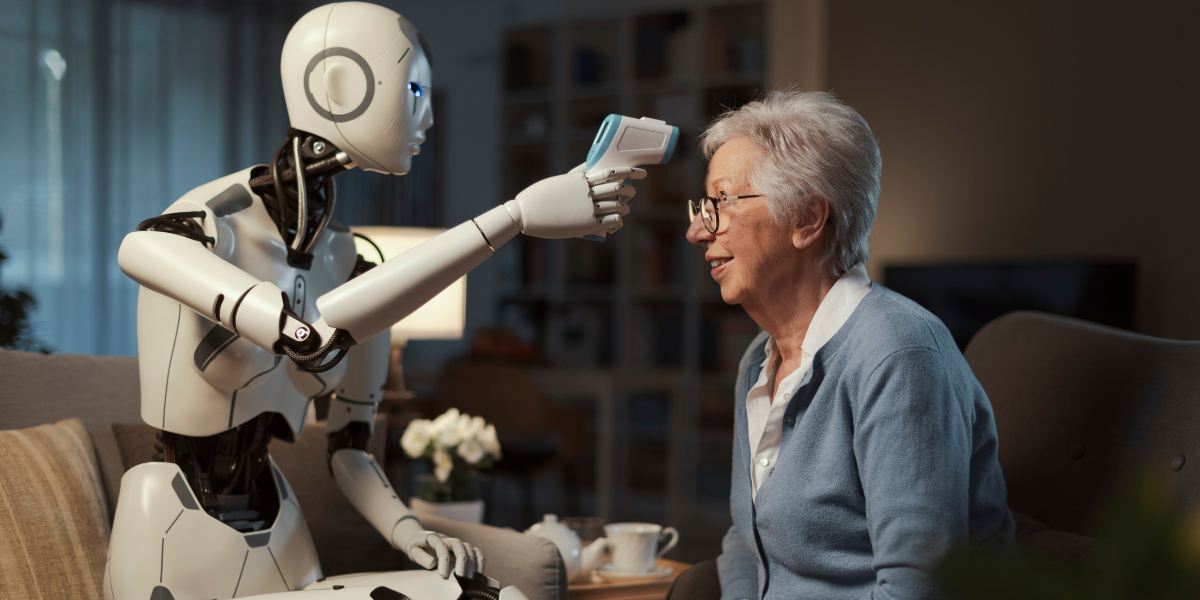
    No sólo ha habido demanda de atención a los ancianos, sino que la pandemia de coronavirus también ha aumentado la necesidad de enfermeras. Según la Federación Internacional de Robótica (IFR), las ventas mundiales de robots médicos iban en aumento antes de la pandemia. Sin embargo, se prevé que se dupliquen en los próximos años. Por ejemplo, Grace es un asistente sanitario robótico diseñado para ayudar a enfermeras y médicos. Hanson Robotics ha desarrollado un robot humanoide equipado con sensores. Este robot tiene una cámara térmica para detectar la temperatura y el pulso de un paciente. También puede diagnosticar enfermedades y administrar tratamientos. La asistencia de Grace fue crucial durante lo peor de la pandemia, cuando la telesalud y la atención sin contacto eran los únicos medios de recibir atención médica.

    ¿Cómo reaccionaría una comunidad de ancianos ante este robot de aspecto humano? Grace se puso a prueba en el Hospital General Judío de Montreal para ayudar a los ancianos a combatir el aislamiento. Todos los residentes podían interactuar con Grace. Está diseñada para escuchar cuando la gente habla, generar respuestas, contar chistes, hablar de temas de interés e incluso moverse moviendo los ojos, el cuello y las manos. Los residentes mayores reconocieron que el centro carecía de personal suficiente y estaba sobrecargado de trabajo. En realidad, no podían pasar tiempo con la población anciana para vencer la soledad.

    Asistencia

    Hay un sinfín de nuevas creaciones de Carebot en todo el mundo con la intención de asistir a las personas mayores y ayudar a quienes tienen limitaciones físicas o de movilidad. La tecnología y la sociedad están cada vez más interconectadas. De este modo, ayuda a los cuidadores o al personal sanitario a disponer de más tiempo para la interacción humana. Ni que decir tiene que los Carebots nunca sustituirán a los cuidados humanos, pero reducirán el desgaste mental de los cuidadores y les proporcionarán eficacia en las tareas diarias.

  • Carebots Can Give Loved Ones A Special Touch

    Carebots Can Give Loved Ones A Special Touch

    Why would Carebots be of interest to Japanese society? Due to a decline in birthrates in Japan, the vast population of people are 65 years old and over. According to the country’s prime minister, Fumio Kishida, births dropped below 800,000 in 2022. He is highly concerned about the country and how it will continue to function as a society. Based on a Merrill Lynch report it projects a shortage of one million caregivers by 2025. However, Carebots have become the most obvious solution for elderly care. To this end, one-third of the Japanese government’s budget is allocated to develop and support Carebots.

    Carebots

    What are Carebots? These are robots specifically designed to assist the elderly or those with limited mobility. The International Organization for Standardization (ISO), is an independent organization that sets standards for more than 160 countries. It has created a standard (ISO 13482) to ensure interactions between Carebots and human safety. The Panasonic Reysone Carebot was the first robot to meet the standard for service robots. How so? The robot transformed from a bed to an electric wheelchair. Another humanoid robot developed in 2015 was Robear, developed by the RIKEN-SRK Collaboration Center for Human-Interactive Robot Research and Sumitomo Riko Company. Robear helps transfer seniors from a bed to a wheelchair or helps those who need assistance to stand up.

    Carebots are not limited to people who are unable to get up from a bed. They can also monitor physical activity, detect falls, and feed them. Others are meant to engage with older people to reduce and prevent cognitive decline and provide companionship and therapy. This will also make it easier for care staff to manage dementia patients. For instance, CT Asia Robotics in Thailand developed the Dinsow, eldercare robot. This specialized bot is purposefully meant to assist seniors. How so? It will assist them by tracking their health, videophone for calls, setting reminders to take medication, and even a built-in karaoke machine.

    Meet Grace

    Not only has there been a demand for elderly care, but the coronavirus pandemic also heightened the need for nurses. According to the International Federation of Robotics (IFR), global sales of medical robots were on the rise before the pandemic. However, it’s predicted to double in the upcoming years. For instance, Grace is a robotic healthcare assistant designed to help nurses and doctors. Hanson Robotics developed a humanoid robot that is equipped with sensors. This bot has a thermal camera to detect a patient’s temperature and pulse. It can also diagnose illnesses and deliver treatments. The assistance of Grace was crucial during the worst of the pandemic when telehealth and contactless care were the only means of receiving medical attention.

    How would a community of elderly people react to this human-like robot? Grace was placed to the test at Montreal’s Jewish General Hospital to help seniors battle isolation. All residents could interact with Grace. She is designed to listen when people talk, generate responses, tell jokes, speak about topics of interest, and even move by rolling her eyes, neck, and hands. The senior residents recognized that the facility was understaffed and overworked. In reality, they could not spend time with the aging population to defeat loneliness.

    Assistance

    There are endless newly innovated Carebot creations throughout the globe with intentions to assist the elderly and help those with physical limitations or mobility. Technology and society are becoming increasingly interconnected. By this means,  it helps caregivers or healthcare workers additional time to provide human interaction. Needless to say, Carebots will never be a replacement for human care but will reduce mental burnout for caregivers and provide efficacy in daily tasks.

  • Platón: La vida es algo más

    Platón: La vida es algo más

    Platón pretendía poner orden y claridad en nuestras mentes. Sugerió que nuestras vidas van mal porque no dedicamos tiempo a pensar detenida y lógicamente sobre nuestros planes. Esto da lugar a un camino que conduce a la infelicidad en nuestras carreras, relaciones y valores, según la filosofía estoica “Visión de Platón”.

    Platón y los viajes al espacio

    Sin embargo, tras 371 días en el espacio, ¿estaría el astronauta Dr. Frank Rubio de acuerdo con Platón? Según la NASA, completó aproximadamente 5.936 órbitas durante su estancia en el espacio. Esto equivaldría a unos 328 viajes de ida y vuelta a la Luna. Completó el vuelo espacial más largo de un astronauta estadounidense.

    Imaginen su reacción cuando se esperaba que llegaran a la Tierra el 28 de marzo, pero los planes cambiaron. Tuvieron que pasar seis meses más dentro de la Estación Espacial Internacional. Al parecer, un trozo de basura espacial o un meteoroide golpeó su nave y provocó una fuga incontrolable en el radiador. Sin duda, no debió de ser fácil vivir en un recinto reducido en compañía de los cosmonautas Sergey Prokopyev y Dmitri Petelin durante un año. Rubio declaró que lo pasó mal al estar lejos de su familia, pero que intentó mantener una actitud positiva durante el periodo de prórroga de su misión.

    El astronauta estadounidense afirma que, de haber sabido la extensión de su misión, habría declinado la oferta. Lamenta haber perdido tiempo con su familia. En una rueda de prensa retransmitida en directo el viernes 13 de octubre de 2023, admite: “Pude… ver qué cosas había hecho bien, qué cosas había hecho mal e intentar mejorarlas para la siguiente mitad de la expedición”, dijo Rubio. Insistió en que aún no era perfecto, pero tuvo “la increíble suerte de poder aprovechar las lecciones aprendidas y aplicarlas inmediatamente. Mucha gente tiene que esperar cinco, seis o diez años [para una segunda misión] hasta que son capaces de poner en práctica esas cosas que acaban de aprender”.

    ¿Podemos sugerir que vivir un año en el espacio nos ayudaría a valorar la “visión de Platón”? ¿Podemos valorar lo que es importante en la vida? El argumento sigue en pie. ¿Dedicamos suficiente tiempo a pensar detenidamente en nuestras decisiones vitales? ¿Podemos, por así decirlo, “pausar” nuestras vidas y reflexionar sobre lo que más importa? En el caso del astronauta estadounidense Rubio, estaba obligado a dedicar tiempo y mejorar. Otros astronautas no tienen el lujo de hacerlo mientras están en el espacio. ¿Es posible tener la “visión real desde arriba”?

    Otro astronauta de renombre, Edgar Mitchell, del Apolo 14. Se convirtió en el sexto hombre en la Luna y fotografió a Alan Sheppard izando la bandera estadounidense en la Luna. Mitchell tuvo la oportunidad de tener una “visión real desde arriba”. Afirmó: “Desarrollas una conciencia global instantánea, una orientación hacia las personas, una intensa insatisfacción con el estado del mundo y una compulsión por hacer algo al respecto”. Desde la Luna, la política internacional parece tan insignificante…”.

    Es humilde dar un paso atrás en nuestros propios problemas, preocupaciones e inquietudes para darnos cuenta de que la vida es mucho más que nosotros mismos. No vivimos en una sociedad para nosotros solos, sino que tenemos el deber de servir a los demás. Según Marco Aurelio, ésta es la ideología estoica de la sympatheia. Estamos interconectados unos con otros y automáticamente sentimos afecto los unos por los otros. Esta filosofía nos proporciona la hermosa visión de lo pequeños que somos en el gran esquema de las cosas.

    Sólo somos un pixel de una gran imagen pixelada

    Puede que no seamos astronautas ni tengamos el privilegio de ver la Tierra desde arriba. Sin embargo, podemos tomarnos un momento para hacer una “pausa”. La filosofía estoica puede aplicarse a nuestra rutina diaria, reflexionando sobre nuestra vida personal y cómo puede afectar a los demás. Si pudiéramos mirar el “panorama general”, sólo somos 1/8.000.000 de la imagen pixelada. Sea como sea, ese píxel puede marcar la diferencia. La pregunta sigue siendo: ¿hay algo más en la vida? Eso depende de ti.

  • Awestruck with Astronauts and Plato’s View From Above

    Awestruck with Astronauts and Plato’s View From Above

    Have you ever felt awestruck by the beauty of the night sky? Imagine the view astronauts are privy to from above and could sympathize with Plato’s perspective. Plato sought to bring order and clarity to our minds. He proposed that our lives go wrong because we do not dedicate time to think carefully and logically about our plans. This results in a path that leads to unhappiness in our careers, relationships, and values according to Stoic philosophy “Plato’s View”.

    Astronaut Rubio and Team Have View From Above

    However, after 371 days in space, would astronaut Dr. Frank Rubio agree with Plato? According to NASA, he completed approximately 5,936 orbits during his time in space. This would be equivalent to about 328 trips to the moon and back. He completed the longest single spaceflight by an American astronaut. Imagine their reaction when they were expected to arrive on Earth on March 28, but plans changed. They had to spend an additional six months inside the International Space Station.

    Apparently, a piece of space junk or meteoroid hit their spacecraft and caused an uncontrollable radiator leak. Without a doubt, it must have not been easy living in a cramped enclosure in the company of cosmonauts Sergey Prokopyev and Dmitri Petelin for a year. Rubio said he had a difficult time being away from family but tried to remain positive during the extension period of his mission.

    The U.S. astronaut claims that if he had known the extension of his mission, he would’ve declined the offer. He regrets missing time with his family. In a live-streamed press conference on Friday, October 13, 2023, he admits: “I was able to … see what things I had done well, what things I had done poorly and try to improve on those for the next half of the expedition,” Rubio said. He emphasized that he still wasn’t perfect but was “incredibly lucky in the fact that you’re able to take those lessons learned and immediately implement them. A lot of people have to wait five, six, or 10 years [for a second mission] until they are able to implement those things that they just learned.”

    Can You Have Plato’s View?

    Can we suggest that living a year in space would help us value “Plato’s view”? Can we evaluate what is important in life? The argument remains. Do we dedicate enough time to carefully think about our life decisions? Can we, so to speak, “pause” our lives and reflect on what matters the most? In the case of U.S. astronaut Rubio, he was obligated to make the time and improve. Other astronauts do not have the luxury to do so while they are in space. Is it possible to take the “real view from above”?

    Another renowned astronaut, Apollo 14’s Edgar Mitchell. He became the sixth man on the moon and photographed Alan Sheppard raising the American flag on the moon. Mitchell had the opportunity to have a “real view from above.” He claimed, “You develop an instant global consciousness, a people orientation, an intense dissatisfaction with the state of the world, and a compulsion to do something about it. From out there on the moon, international politics look so petty…”

    Sympatheia

    It is humbling to take a step back from our own problems, concerns, and worries to realize there is more to life than ourselves. We do not live in a society by ourselves, but we have a duty to serve others. According to Marcus Aurelius, this is the Stoic ideology of sympatheia. We are interconnected with each other and automatically have an affection for one another. This philosophy provides us with the beautiful insight to view how small we are in the grand scheme of things.

    We might not be an astronaut or have the privilege to view Earth from above. However, we could take a moment to “pause”. The Stoics philosophy can be implemented in our day-to-day routine, by reflecting on our personal lives and how it can affect others. If we could look at the “big picture”, we are only 1/8.000.000th of the pixelated picture. Whatsoever, that pixel could make a difference. The question remains, is there more to life? That is up to you.

  • Hola, me llamo ANDI

    Hola, me llamo ANDI

    ANDI: Respira, suda y camina.

    ¿Qué ocurre en el cuerpo humano durante un golpe de calor? ¿Cómo los humanos pueden protegerse con el aumento de las temperaturas?

    El desarrollo de robots maniquí son modelos con forma humana que ayudan a simular escenarios médicos, quirúrgicos o clínicos. Thermatrics es una empresa de tecnología de medición térmica que fabrica un robot a medida para la Universidad Estatal de Arizona (ASU). Advanced Newton Dynamic Instrument, o ANDI, es el primer robot maniquí térmico del mundo que respira, suda y camina en interiores y exteriores. El alarmante cambio climático impulsó a los investigadores a crearlo. Un robot capaz de soportar casos extremos de calor. ¿Qué hace que este robot maniquí no sea como los demás?

    Thermetrics ha creado 10 robots que logran sudar, pero ANDI es el único con la capacidad de poder ser sometido a altas olas de temperaturas

    Puede imitar las funciones térmicas del cuerpo humano en 35 superficies con sensores de temperatura, flujo y poros de sudor. Konrad Rykaczewski, profesor asociado de la Escuela de Ingeniería de la Materia, el Transporte y la Energía, aborda la importancia de aprender del robot maniquí. Además, también puede proporcionar una mejor comprensión de cómo afecta el calor al cuerpo humano. Sorprendentemente, sus funciones se limitan a generar calor, temblar, caminar y respirar.

    Cuesta alrededor de medio millón de dólares (451.000 euros) y puede simular cualquier edad, fisionomía, condición física o médica, por lo que su utilidad es amplia y versátil. Los científicos pueden utilizarlo para estudiar diferentes actividades como correr o para monitorear diferentes partes como los órganos.

    También se estudia la posibilidad de crear versiones para segmentos más específicos como los puestos de trabajo en relación con la temperatura, mejorando las condiciones legales o proponiendo la ropa más idónea.

    Los investigadores de la ASU están poniendo a prueba ANDI y MRTy (el robot de calor biometrológico de temperatura radiante media de la ASU). Empiezan simulando situaciones de exposición al calor en una cámara de calor desarrollada que puede alcanzar los 140 grados Fahrenheit. A partir de los ensayos, “MaRTy puede decirnos cómo modifica el entorno construido la cantidad de calor que llega al cuerpo, pero MaRTy no sabe lo que ocurre dentro del cuerpo. MaRTy mide el entorno y luego ANDI puede decirnos cómo puede reaccionar el cuerpo”, afirma Ariane Middel, profesora adjunta de la Facultad de Artes, Medios de Comunicación e Ingeniería.

    Este dúo dinámico descubrirá nuevas perspectivas para los investigadores. Sin embargo, ANDI puede ofrecer mucho más. Como tiene canales de refrigeración internos, el agua fría circula por todo su cuerpo para mantenerlo fresco frente a condiciones de calor abrasador. Esto proporcionará a los investigadores una mejor comprensión de la hipertermia, que está afectando al creciente crecimiento de la humanidad global.

    Herramientas como estos robots son fundamentales para que la ciencia aporte soluciones y proponga nuevas posibilidades para las personas ante la subida de las temperaturas, en un contexto en que cada vez son más comunes las temperaturas elevadas.

  • Hello, Meet ANDI-A Manikin Robot

    Hello, Meet ANDI-A Manikin Robot

    The development of manikin robots are human-shaped models that have revolutionized our lives in endless ways. These specialized robots help simulate medical, surgical, or clinical scenarios. I believe you’d love to meet one of them.

    ANDI

    Thermatrics is a thermal measurement technology company that custom-built ANDI for Arizona State University (ASU). Advanced Newton Dynamic Instrument, or ANDI, is the world’s first indoor-outdoor breathing, sweating, and walking thermal manikin robot. The alarming climate change prompted researchers to create ANDI. A robot that can withstand extreme cases of heat. What makes this manikin robot unlike any other?

    ANDI can mimic human body thermal functions in 35 surface areas with temperature, flux sensors, and sweat pores. Konrad Rykaczewski, an associate professor in the School for Engineering of Matter, Transport, and Energy, addresses the importance of learning from the manikin robot. Amazingly, its functions are limited to generating heat, shivering, walking, and breathing. Thus, this specialized manikin robot can be extremely useful and provide a better understanding of how heat impacts the human body. 

    The Dynamic Duo

    ASU researchers are putting ANDI and MaRTy (ASU’s Mean Radiant Temperature biometerological heat robot) to the test. They start by simulating heat-exposure scenarios in a developed heat chamber that can go up to 140 degrees Fahrenheit. 

    Based on the trial runs, “MaRTy can tell us how the built environment modifies the amount of heat that hits the body, but MaRTy doesn’t know what happens inside the body. MaRTy measures the environment, and then ANDI can tell us how the body can react,” states Ariane Middel, assistant professor in the School of Arts, Media, and Engineering

    MaRTy is a great mobile tool that measures air temperature, humidity, wind speed, and direction, and GPS direction.  Studies proved that after a “thermal walk” around Phoenix, (one of the hottest and dryest cities in the United States) with the heat robot, that thermal alliesthesia was affecting many residents. Thermal alliesthesia is a change to a sensory experience that causes negative effects on the human body. 

    This is one of the many research studies demonstrating warming trends in cities, especially in the extreme summer heat. Several publications and data evaluate radiant heat temperatures with the hope of decreasing thermal exposure in pedestrian walks.  

    A smaller version of MaRTy, MaRTyini will be implemented in the city of Tempe, Phoenix to further research on how the use of public space changes with the heat. 

    This dynamic duo will uncover newly fed insights for researchers. However, ANDI can offer much more. Since it has internal cooling channels, cool water circulates throughout its body to keep it cool from scorching heat conditions. This will provide researchers with a better understanding of hyperthermia, which is affecting the increasing growth of global humanity. 

    Hope for the Future

    ANDI has given us hope for the future. As a result of the data collected and researched, researchers can develop cooling clothes or exoskeleton for backpacks. These new ideas provide a holistic approach and solutions to the existing global climate change, which is a topic of increase concern to several societies. Arizona State University and the National Science Foundation Leading Engineering for America’s Prosperity, Health, and Infrastructure are trailblazers in this field to provide a “cooler” society in “boiling” circumstances. 

    Furthermore, ANDI will continue to save lives as he continues to be placed to the test. This robot will provide answers to people dying of heat in extreme heat situations. Researchers will better understand how our bodies are impacted by heat and the risks of environmental factors. 

    Interested in how AI is revolutionizing (in a positive way) healthcare? Check our other post here

Este lloc web usa cookies per a que vosté tinga la millor experiència d'usuari. Si continua navegant està donant el seu consentiment per a l'acceptació de les mencionades cookies i l'acceptació de la nostra política de cookies, punche l'enllaç per a major informació. View more
Acceptar